
If the Binaries Exist: Rescuing a Lost 2009 Mobile Game Nobody Played
TL;DR: I used AI to tear down a delisted, undocumented 2009 mobile game — dead file format, dead hardware, no tooling support — and rebuild it as a native port that will outlive every device that could run the original. The game itself is a curiosity. The point is what the exercise demonstrates: reverse engineering has stopped being expensive, which changes who can do software preservation, how much of our digital culture might actually survive, and how long yesterday’s DRM keeps meaning anything. If the binaries exist, AI can and will take them apart. Code: relapse-resistance — alpha-quality engine-only builds on the releases page; you supply your own IPA.
In 2009, Eminem’s comeback album Relapse got the full promotional apparatus: singles, a horror-styled video campaign, and — announced by tweet, released on album day for $2.99 — an iPhone game. Six levels, 41.7 MB, built by a small Florida contract studio in the App Store’s first year, on a marketing deadline. You don’t need my opinion of it, because 2009 left one on record: the only contemporary review I could find — and that I could find only one is its own data point — declared it “literally the worst game I have ever been subjected to in my entire life”, while a launch-week blog post settled for “Relapse = FAIL”. It was quietly delisted — still on the store when that review ran six weeks in, gone at some unrecorded point after — and almost nobody played it then or has thought about it since.
The premise, when you reach it, takes some easing into. You play Eminem fighting his way out of a psychiatric rehab facility, and the things standing between you and the exit are the patients. You punch them — and the orderlies, and the doctors — to earn “will power points”. At 400 points a 9mm materialises. At 1200, an M16. If your tolerance meter fills, the screen says YOU RELAPSED and you start again. It is, in short, a deeply strange object: an official, label-adjacent product with the logic of a fever dream, very much of a year when the App Store would approve a taser-noise app and nobody blinked. File that strangeness away; it turns out to matter for the preservation question, not just the curiosity one.
Meanwhile, its very unloveliness is what makes it the right specimen: no community was ever going to do this work, so it’s a clean test of what one person and an AI can manage alone. The game is now fully extracted, decompiled, audited method by method, and reimplemented as a native C++ port that runs on Linux, Windows, Android and — cross-compiled from Linux with no Mac in sight — iOS. It will outlive every device that could ever run the original. The gap between what this thing is and what it took to save it is the story, and I don’t think the implications stop at novelty promo games.
Popsomp Hills, $2.99, and the sequel that never came
The game was credited to “Shady Games and DS Media Labs” — the former
presumably the artist-side label (the bundle ID is
com.shadygames.Relapse), the latter a real and traceable studio. DS Media
Labs, Inc. was a small iPhone contract shop working out of the West
Palm Beach area (four of them flew to WWDC ‘09), and their archived blog reads like a core sample of the
early App Store: a taser-noise app (Stun-O-Matic), a light-cycles clone
(Light Riders), FLOverload, a Fall Out Boy All Access app, and — a few
months after Relapse — Ramp Champ, a genuinely well-regarded skeeball game
built with The Iconfactory. In mid-2009 they posted a job listing for a 3D
developer: “Unity 3D, Mathematics, C# and the Mono/.NET frameworks”,
OpenGL ES a bonus. That listing is effectively this game’s build manifest —
it describes the exact stack the teardown later fell out of.
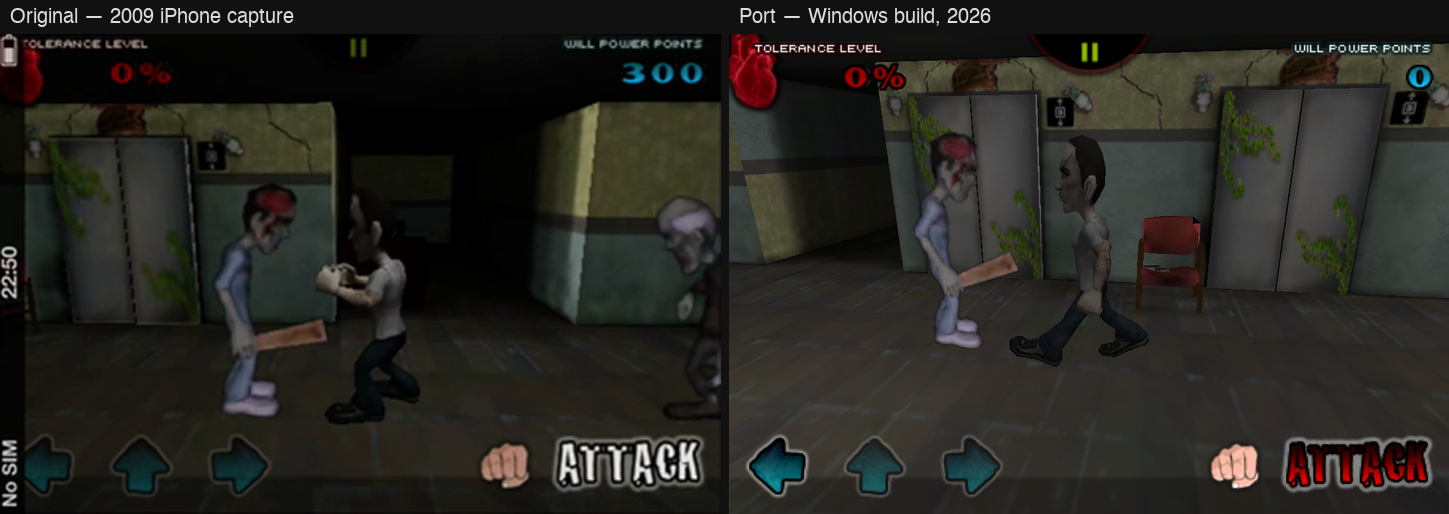
The launch beat was real, if brief. On May 3, 2009 Eminem tweeted “Relapse iPhone game coming along nicely” with a screenshot: a buff mini-Em squaring up to a bloody-faced zombie in a decrepit lobby. MTV News picked it up two days later; Pocket Gamer covered it the day after that and wondered whether Apple would even approve it, the App Store having recently rejected a Nine Inch Nails app for “objectionable content”. Apple approved it. The game landed on May 19, 2009 — album day — at $2.99, with a trailer on Skee.TV. The studio’s own blurb: “you assume the role of Eminem as he fights his way out of Popsomp Hills, the rehab center he was remanded to. Insane patients, Orderlies, and Nurses will stop at nothing to see that Em never makes it out alive.” (The blurb says Nurses; the code says Doctors. Even the marketing copy and the enemy table disagree.)
A week after launch, the same blog post promised version 1.1: longer
levels, smarter AI, a more responsive Eminem and a skippable intro. And
when you finish the game, the ending video closes on three words in
scratched grindhouse type: TO BE CONTINUED… — I pulled that frame out
of the shipped end.m4v myself.
None of it happened — as far as anyone can prove. The game vanished from
the App Store not long after launch and took the whole plan with it. No
continuation, no sequel; and whether 1.1 itself ever landed is now
unknowable in an instructive way. The one binary that survives is 1.0 —
the archive.org item is literally named relapse-1.0.0. If an update did
ship in the game’s short time on the store, nobody kept a copy, and the
App Store keeps no public record of version history for software it has
delisted. So the promised patch is either vapour or lost media nested
inside lost media — a version of a game nobody preserved, of which we
cannot even establish the existence. That is how thin the record gets,
seventeen years out, for anything that lived only in a storefront. A “to be
continued” in a delisted binary is about as clean a monument to abandoned
digital culture as you could design on purpose.
The fifteen-year hunt
None of this starts with me. It starts with a YouTube documentary, The 15 Year Hunt For The Lost Eminem Game, which records how a chain of volunteers dragged Relapse: Resistance back from the edge of lost media. The short version: the IPA surfaced anonymously on archive.org in July 2024 and sat unnoticed for months. When it was finally found, the game’s framework turned out to be gone from iOS 10 onward — it needs iOS 9 or earlier — forcing everything onto period hardware — a six-hour guided jailbreak of an eBay iPhone 3G, a dead Wi-Fi chip that nearly ended the whole project, a defunct screen-mirroring utility brought back from the grave by spotting a broken domain prefix in a URL, strangers donating decade-old hardware to the cause. If you have any affection for a lost-media quest, watch the documentary — the people who made each step happen are credited there, and the full story is better told at video length than I can manage here.
That is what software preservation actually looks like: unglamorous, contingent, and absurdly disproportionate to the artifact — years of volunteer effort to get an obscure album tie-in running long enough to point a camera at it. And at no point does anyone in that story stop to ask whether the game deserved it, which is the correct attitude. Preservation that only saves the good stuff isn’t preservation, it’s curation, and the culture of 2009 includes its marketing sludge whether we like it or not.
Life support has a clock on it
What that group achieved is best described as life support. The game runs — on a shrinking pool of 32-bit ARM devices, behind jailbreaks, with capture rigs held together by community generosity. The binary is armv6. Apple dropped 32-bit app support in iOS 11 and armv6 fell out of the toolchain years before that; there is no simulator slice in the IPA, and no emulator runs it — that has been tried. Period hardware is the only path, every year there is less of it, and when the last capacitor in the last iPhone 3G gives out, “the game runs” stops being true forever.
I wanted the other kind of preservation: the kind where the artifact no
longer needs its host. Extract the assets, the constants and the behaviour
into an open specification, reimplement against commodity APIs, and the game
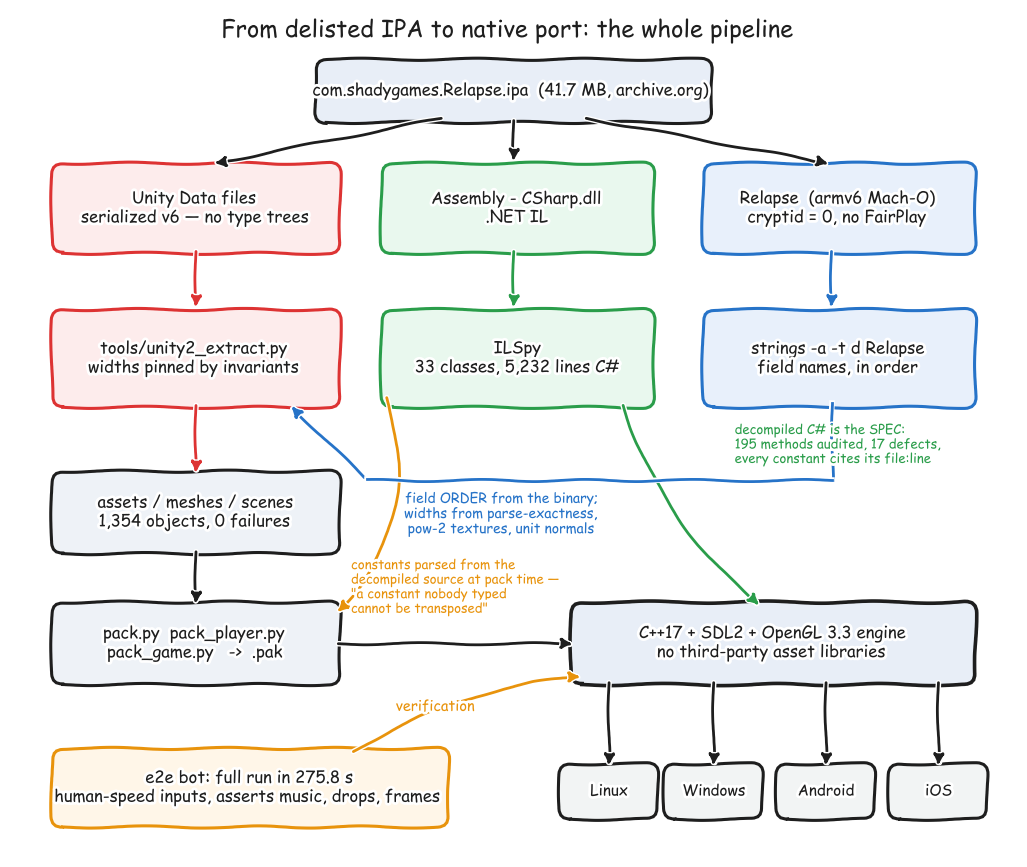
survives the hardware. So that’s the project — a full teardown of the
archive.org IPA (md5 d3ef1baa8a2e15264b3ca62f725adcab, verified against the
upload) and a native port: C++17, SDL2, OpenGL 3.3, one binary, no
third-party asset libraries.
The format nobody could read
Here is where it gets properly low-level, because the first wall is a good one.
The IPA’s Unity data files are serialized-file format version 6 — Unity iPhone 1.0.2f4, 2009. Later Unity formats can embed a type tree: a schema, per class, describing every field and its width, so a tool can walk any object without prior knowledge — and where a build strips it, modern tools fall back on curated type databases. Version 6 has neither option. No type trees, no version string, just an object table — offsets, sizes, class IDs — and then opaque bytes. UnityPy and AssetRipper will happily enumerate the objects and then shrug at every body: their type databases reach back a long way, but not to 2009. Nothing here is encrypted or obfuscated. The format is merely forgotten, which for preservation purposes is indistinguishable from protected.
So the schema had to be reconstructed, and it came in two halves.
Field order came from the shipped binary itself. Unity’s serializer registers field names in order, and those names survive as plain strings in the armv6 Mach-O — so the string table preserves the field sequence. One command gives you the skeleton of the Mesh serializer:
strings -a -t d Relapse | grep m_IndexBuffer
# and its neighbours in the string table: m_SubMeshes, m_Vertices, ...
The 2009 binary carries its own field manifest, in order, for every serializable class. It just doesn’t tell you how wide anything is.
Field widths came from constraint-solving against the data. Pick candidate widths, parse, and check invariants that cannot hold by accident:
- a parse must consume its object exactly — end one byte short or long and the candidate dies;
- texture dimensions must be powers of two;
- every mesh index must be less than the vertex count;
- normals must be unit length.
Guess wrong and something violates one of those within a handful of objects. Guess right and 1,354 objects parse with zero failures — which is what happened. That’s the whole trick: the file format documents itself if you hold it to standards it can’t fake.
Some of what fell out, for flavour:
- Meshes are 16-bit triangle strips (2009 iPhone GPU, of course they
are), de-stripped to triangle lists at pack time.
TangentSpaceis seven floats per vertex — normal, tangent, handedness. Skin weights and bind poses parse too; the player is a 34-joint skeleton with 37 animation clips. - AudioClips come in two flavours: trailing raw PCM16, or raw AAC access
units with a CoreAudio ASBD, an
esds, and a 16-byte-per-packet table — and no ADTS framing, so nothing will play them as-is. The extractor reframes the packets into ADTS; decoded durations match the storedm_Lengthto within one 23 ms packet, which is how you know the reframing is right and not merely tolerated. - Shaders: 75 ship, 28 mention shadows, and precisely none of the shadow ones are used by any of the game’s six materials — the iPhone player is OpenGL ES 1.1 fixed-function and every shadow you see is baked into five lightmap textures. Sweeping the binary to prove a negative (no real-time shadows, no fog, no projectors — nothing to port) is as much a part of fidelity as implementing things.
The other half of the ground truth was a gift: the game logic ships as
Assembly - CSharp.dll, .NET IL, and IL decompiles into something
substantially identical to the original C#. 33 classes, 5,232 lines — the
entire game, readable. And the Mach-O has cryptid = 0: this app was
never FairPlay-encrypted. No protection was circumvented because there
was no protection. The whole game sat in the open; it just took fifteen
years and a chain of volunteers before anyone could look.
Decompiled code as specification — and getting burned by it
The port treats the decompiled C# as a spec, and the fidelity audit
(FIDELITY.md: all 195 methods across the 33 types, every ported constant
required to cite the file:line it came from) is honest about how that
went: 17 defects. A few generalise well beyond this game.
D1, the transposed weapon table. Weapon’s constructor is
Weapon(WeaponType type, bool automatic, float effectiveRange, float damage, int defaultAmmo)
Range third, damage fourth — semantics fixed by how the body uses them
(_effectiveRange feeds Physics.Raycast’s distance, _damage feeds
ApplyDamage), not by what the decompiler names anything. The port had read
the table sideways. The fist — real damage 0.25 against enemy health of
1.0–1.5 — was doing 1.25. The handgun was doing 10, which is its range.
The rifle was doing 20. Fist 5× too strong, handgun 25×, rifle 40×. Every
enemy in the original takes four to six punches; in the port they were dying
in one. Worse, the automated end-to-end test had been built on the wrong
numbers, so fixing the bug broke the test — the test suite had encoded the
defect as an expectation. The playthrough got 50 seconds slower when the
numbers were corrected, because the bot now has to stand and fight instead
of one-punching its way through the hospital. Fidelity, measured in
inconvenience.
D5, the jump that was never a jump. The port implemented a ballistic
arc — jump_speed = 5.2, gravity = -14.0, a landing test. Reasonable,
obvious, and entirely invented: neither constant exists anywhere in the
original. ActorController.Update ends with, unconditionally, every frame:
transform.position = new Vector3(transform.position.x, 0f, clampedZPlane);
Y is pinned to zero. The original’s jump is an animation, a sound, and an
invulnerability frame — Weapon.Attack refuses to damage a jumping actor,
so the “jump” is actually a dodge you can spam (that’s D4, a real mechanic
hiding behind a fake one). The character never leaves the floor. Restoring
this makes the jump feel broken to anyone who only knows the port, which is
exactly the point.
D6, the wrong easing curve. Both the player and the camera use
Mathf.SmoothDamp — a critically-damped spring, an exponential approach
that never quite arrives. The port had a linear ramp that hits the target
and stops dead. Different response, different stopping distance, different
camera lag. The fix is cheap because SmoothDamp is fully specified — it’s
a short polynomial approximation of the exponential, and the original’s
tuning (maxWalkVelocity 4.0, accelerationTime 0.15) comes straight out
of the scene data.
D14, the most useful negative result. Two classes on the “missing”
list — CameraFadeInOut, LoadingLevelController — are unreachable in the
shipped build. One is attached to no GameObject in any scene and referenced
by no script. The other ships inactive, and both call sites that would
show it are gutted into empty bodies — literally
if (loadingLevelScreen != null) { }. Someone at the studio stubbed the
loading screen out and shipped. Implementing these classes would have made
the port less faithful. Sixteen methods of apparent work, correctly not
done: a class existing in the assembly says nothing about it running.
D8, where faithful and correct disagree. Level 5 has two exit triggers
and both load MainMenu — one of them 6.58 units behind the spawn. And
GameController.LoadScene ends with:
if (Application.loadedLevelName == "Level5") PlayerPrefs.SetInt("PlayEndingSequence", 1);
— on any departure from Level5. Walk six units the wrong way at the
start of the final level and you get the ending video. That is a bug in the
2009 game, faithfully preserved and written down as a decision, because
otherwise someone “fixes” it back and forth forever. (The level data even
contains the clean fix if ever wanted: the forward exit is always the child
of the elevator carrying the ElevatorDoorOpener script. Noted, declined.)
D16, the moonwalk. The original tracks movement as four booleans —
movingLeft, movingRight, wantsToMoveLeft, wantsToMoveRight — and
they encode something a signed axis cannot: press right while holding left
and the new input parks in wantsToMoveRight while lookDirection stays
put, so you walk right while facing left, and the animation controller runs
the walk cycle at negative speed. The port had summed the two keys to zero
and stood still. Eminem is supposed to be able to moonwalk. He now can. The
animation sampler had to learn to wrap negative time to make the clip play
backwards, which is possibly the most effort ever spent on a feature no
player will find.
And the rule that would have prevented most of the seventeen: every defect
was a hand-transcribed constant. Values read out of the shipped scene data
at pack time — enemy health, walk speeds, camera bounds, spawn frequencies —
never drifted, not once. Values that lived in code and were retyped by
hand into a header did. A constant nobody typed cannot be transposed. The
fix is structural: parse WeaponFactory’s constructor calls out of the
decompiled source at pack time and emit them into the data files, and treat
any uncited constant in the port as suspect — the four uncited floats in
game.h are exactly what turned out to be wrong.
The port, briefly
C++17, SDL2, OpenGL 3.3. Offline tools bake the extracted data into three pack formats: per-level paks (textures as raw RGBA, de-stripped meshes, baked world matrices, the scene camera, spawn parameters, exits), a player pak (skeleton, skinned mesh, weapon attachments bound to wrist joints, 37 clips), and a game pak (sprite atlases with precomputed UVs, all audio pre-decoded to 22.05 kHz mono PCM16 so the runtime needs no codec).
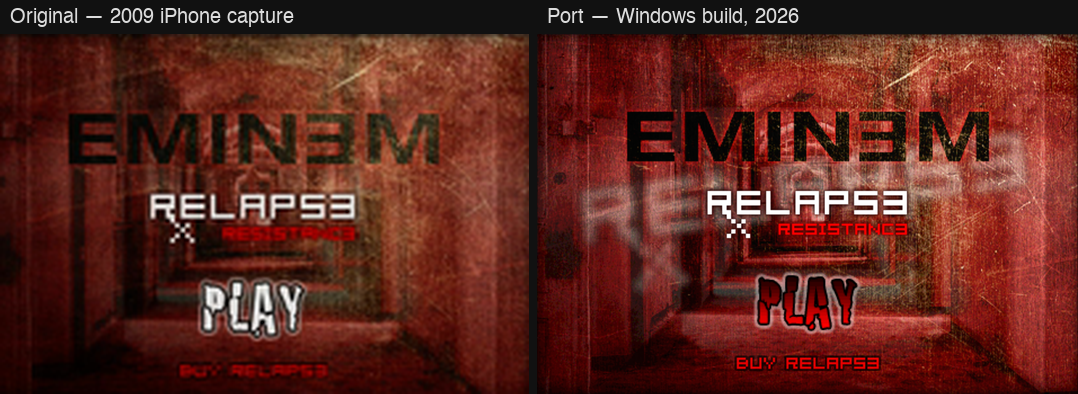
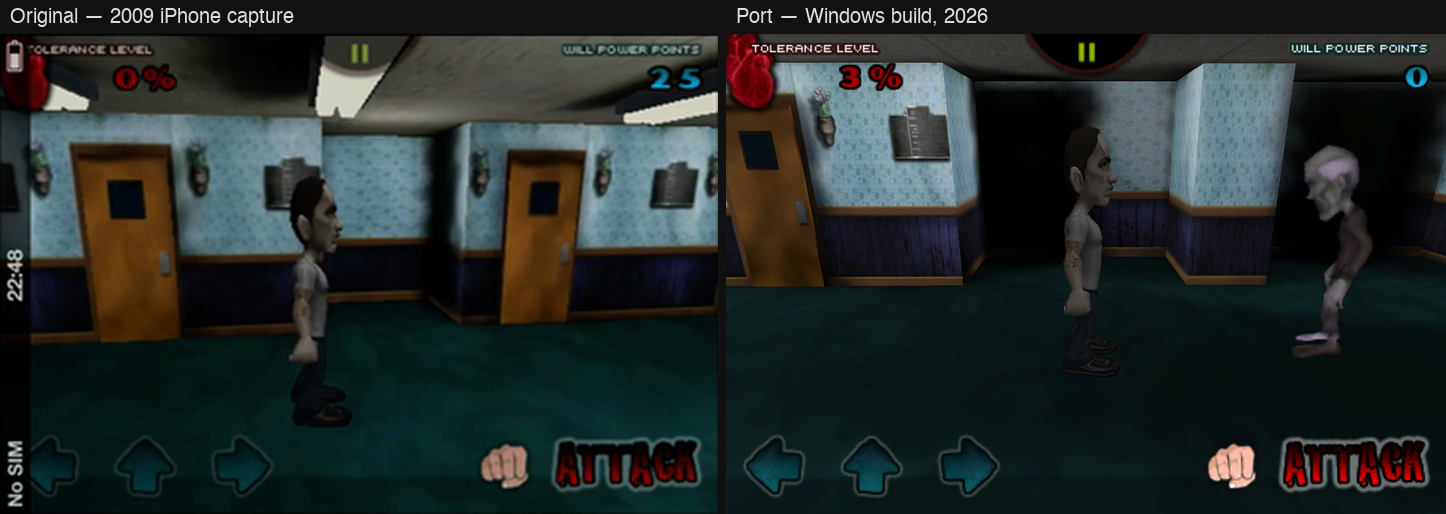
The source, the extraction tools and the audit documents are on GitHub: AdamLovattDevOps/relapse-resistance. The releases page carries engine-only builds — Windows, Linux, an AppImage — that contain no game content: you download the IPA from archive.org yourself, verify the hash, and the tools generate the data files locally. The APK isn’t published at all, because Android bakes the data into the archive itself. Fair warning that the port is alpha and experimental — it plays start to finish and passes its test suite, but the known gaps (no collision against room geometry, no extras menus) are listed in the README, and the fidelity audit is ongoing. I proved the bring-your-own-IPA path end to end before publishing this: fresh clone, fresh archive.org download, hash verified, full extraction and pack run, a clean cross-compiled exe, and a playable game on a Windows machine that had never seen the project.
The end-to-end test plays the game with a bot that inputs no faster than a human — about three attacks a second, a jump or two per level, no fast-forward, deliberately no way to add one — and asserts what actually happened: every level reached, the right music on each, footsteps, screams, the 9mm dropping at 400 points with its holster sound, a screenshot per level, none of them black or blown out. Four scenarios, including a pacifist run (must die) and a backtrack run (walking out of a level’s entrance exit must return to the title without counting as a win). Full playthrough: 275.8 seconds.
The iOS build deserves a paragraph, because it is built on Linux. lld
speaks Mach-O, so stock clang plus an iPhoneOS SDK sysroot plus ldid for
signing gets you an .ipa with no Mac involved. Three things a Mac would
have silently hidden: SDL2 mixes ARC .m files with manual-retain .c
files, so -fobjc-arc has to be set per file — one global setting fails
whichever way you set it; Apple’s @available runtime check
(__isPlatformVersionAtLeast) lives in Apple’s compiler-rt, which Ubuntu’s
clang doesn’t ship, so a small compat shim reads kern.osproductversion the
way the real one does; and the difference between a fullscreen app and a
letterboxed compatibility-mode one is an empty UILaunchScreen dict in
Info.plist — the alternative is a compiled storyboard, which needs actool,
which needs a Mac. There is a pleasing symmetry in the port returning to
iPhone hardware via SideStore, on a signing certificate that expires every
seven days: the original platform is now the least hospitable one this
game runs on.
The disproportion, stated plainly
Hold the two halves next to each other.
On one side: a six-level advergame where Eminem punches hospital patients, shipped to sell an album, with a stubbed-out loading screen and a bug that rolls the credits if you walk left. Nobody played it. On the other: a frontier AI system reconstructing an undocumented seventeen-year-old serialization format from the binary’s own string table, constraint-solving field widths against parse-exactness and unit-length normals, reframing headerless AAC by packet table, auditing 195 decompiled methods against a reimplementation, and catching the exact place where a decompiler’s parameter names disagreed with the argument semantics.
The disproportion is the point. This level of effort used to be reserved for software a community could sustain obsession over — Mario 64, Ocarina of Time, decompilations with decades of person-years behind them. The economics gatekept preservation: only the beloved got saved. What this project demonstrates, in a small way, is that the economics have flipped. The cathedral treatment now costs one person a few weeks, so the janky ad gets the cathedral treatment — and “is it worth it?” stops being a technical question at all.
So ask the non-technical version honestly: should anyone bother preserving what is essentially an advertisement? I think the question contains its own answer, because nobody knows in advance. Nobody in 2009 flagged this game as culturally significant — it took fifteen years for anyone to notice it was gone. The App Store has delisted software by the hundreds of thousands; Flash took a whole medium with it; every dead platform strands a generation of work, and the overwhelming majority of it — almost certainly the vast majority of all digital art ever made — will simply not survive, because survival currently depends on someone caring at exactly the right moment. And some of it will be lost on purpose: a product this strange, this far from how its rights holder wants to be remembered, is exactly the kind of asset that gets quietly left to rot. Embarrassment is a preservation risk in its own right — nobody works to keep their oddities online — and deliberate forgetting is still forgetting. There is no legal deposit library for mobile software. No institution was ever coming for Relapse: Resistance. The people who led this charge were an anonymous uploader, a fan who got curious, a jailbreaker with a free evening, and a YouTuber — volunteers, every one, doing institutional work with none of the mandate and none of the budget. If that’s who leads, then the thing that changes the percentage isn’t more institutions. It’s dropping the cost of the work until the volunteers can afford everything.
What happens when this scales
Which brings me to the thesis, and it’s the uncomfortable one.
Everything above worked because the artifact couldn’t fight back. A 2009
Unity game has no type trees, but it also has no anti-tamper, no server-side
logic, no attestation — and, thanks to cryptid = 0, not even the
encryption its own platform offered. But look at what the method actually
was: recover structure from strings the binary couldn’t help shipping; pin
the unknowns with invariants; treat decompiled output as a specification;
audit the reimplementation against it adversarially. None of that is
game-specific. It is a general procedure for digesting binaries, and every
step of it rides the same capability curve the models do.
Scale it up and the targets stop being novelty games. Bigger games. Middleware. Operating systems. The 90s and 2000s are full of software protected by schemes that were economically secure rather than mathematically strong — SafeDisc, SecuROM, dongle checks, bespoke archive formats, licence blobs. These were never walls. They were toll booths, priced against scarce human attention: not worth a skilled reverser’s month for an abandoned CAD package or a dead MMO client. AI reprices human attention. The month becomes an afternoon, the afternoon becomes a batch job, and old DRM doesn’t get broken so much as outlived — it was always executing on the attacker’s own hardware, holding its keys somewhere in the process, and obscurity was the only thing it ever really had.
So I’ll state it flatly: if the binaries exist, AI can and will take them apart. Decrypt the weak stuff, strip the protection, recover the formats, port the lot. Not tomorrow and not all at once, but monotonically — every artifact that survives in binary form is on a conveyor belt toward legibility, and nothing on the protection side of the ledger compounds the way the analysis side does.
For preservation this is straightforwardly liberating, and this project is the demonstration. The alternative was watching the last armv6 iPhone die. Every abandoned format, every orphaned save file, every dead middleware runtime is now recoverable in principle and increasingly in practice — and the unloved artifacts benefit most, because they were never going to earn a fan decompilation. The DMCA’s preservation exemptions were drafted imagining museums and libraries with staff reverse-engineers; the reality is going to be individuals with a model and a weekend, and the legal framework has not begun to metabolise that.
For rights holders it is the same fact with the sign flipped, and I won’t pretend otherwise. The tool that reconstructs a delisted 2009 advergame from serialized bytes reconstructs a live product just as readily. The distinction between this project and piracy is legal and ethical, not technical: the game is delisted and unmonetizable; nothing extracted is redistributed — the repo ships tools and audit documents and readers supply their own IPA; and the binary was never encrypted, so no protection measure was touched. Those lines matter and I’ve stayed on the right side of every one. But they are lines I drew. The capability doesn’t draw them, and the next person holding it might not either.
Coda
Nobody needs this port. Almost nobody wanted the game the first time. That was never the question. The question was whether a piece of 2009, silly as it is, outlives the hardware it was chained to — and whether one person with an AI can now do for the unloved what whole communities used to do for the beloved.
It does, and they can. The volunteers in that fifteen-year chain proved this thing was worth saving, so that the saving could take a few weeks. Go watch the documentary.
The port’s source, extraction tools and audit documents are the publishable output of this project. The game’s code, art and music remain the property of Shady Games / DS Media Labs; no game content is redistributed, and the tools require you to supply your own IPA.